
Every relationship faces periods of stress, disconnection, or misunderstanding. Busy schedules, financial concerns, family responsibilities, health issues, and major life transitions can place pressure on even a strong partnership. Over time, small disagreements may become recurring conflicts, and meaningful conversations may become harder to have.
Couples counseling in Brookline gives partners a private and supportive place to talk openly, understand one another, and work toward practical changes. You do not need to wait until your relationship reaches a crisis point. Many couples seek counseling because they want to protect their connection, address concerns early, or build a healthier foundation for the future.
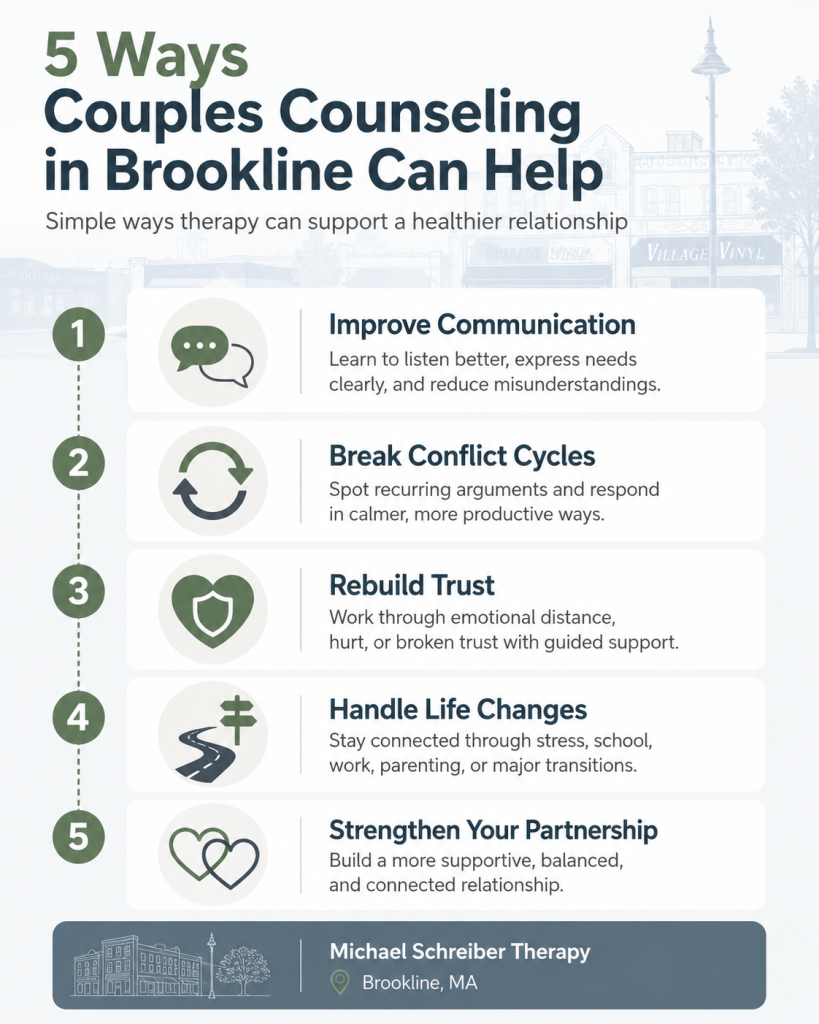
Here are five ways couples therapy may benefit your relationship.
In this article:
–Improve communication: Couples counseling in Brookline can help partners listen better, express needs clearly, and reduce misunderstandings.
–Break unhealthy conflict patterns: Therapy can help couples recognize recurring arguments and respond in calmer, more productive ways.
–Strengthen trust and connection: A Brookline relationship therapist can support couples through emotional distance, major life changes, and rebuilding trust.
We at Michael Schreiber Therapy specialize in anxiety therapy, couples counseling, and medication management in Brookline, MA, serving Boston, Allston, Brighton, Cambridge, and Newton. Our work is patient-centered, direct, and compassionate, helping students, couples, adults, and members of the LGBTQIA+ community reduce symptoms, improve communication, and move toward steadier daily life. To schedule support, contact us or call (617) 730-8048.
1. Improve Communication Between Partners
Communication involves much more than choosing the right words. Tone of voice, body language, timing, assumptions, and past conflicts can all affect how a message is received.
One partner may feel ignored, while the other feels criticized. One person may withdraw during conflict, while the other tries harder to continue the conversation. These patterns can leave both people feeling frustrated and misunderstood.
A relationship therapist can help you recognize the communication habits that keep arguments going. During counseling, couples may practice expressing concerns clearly, listening without immediately reacting, and discussing difficult subjects with greater respect.
Improved communication can help you:
- Express needs and feelings more directly
- Listen without interrupting or becoming defensive
- Recognize unhelpful communication patterns
- Discuss sensitive topics more calmly
- Feel heard and understood by your partner
These skills can support the relationship long after counseling sessions end.
2. Break Repeating Cycles of Conflict
Many couples argue about the same subjects again and again. The topic may involve household responsibilities, finances, intimacy, parenting, family boundaries, or how time is spent. Although the details may change, the emotional pattern often remains the same.
For example, one person may raise a concern, the other becomes defensive, and the conversation quickly turns into blame or withdrawal. After the disagreement ends, neither partner feels that the original concern was resolved.
Couples counseling can help you slow down this cycle and look beneath the surface of the argument. A counselor may help each person identify the feelings, fears, or unmet needs that contribute to the conflict.
When it comes to relationship counseling, the goal is not to decide who is right or wrong. The goal is to help both partners understand the pattern and learn healthier ways to respond.
Over time, this work may reduce the intensity and frequency of arguments. It can also make it easier to repair the relationship after disagreements occur.
3. Rebuild Trust and Emotional Connection
Trust can weaken for many reasons. A breach of trust may involve infidelity, secrecy, financial decisions, broken promises, or emotional distance. In other relationships, trust fades gradually because one or both partners no longer feel supported, valued, or emotionally safe.
Rebuilding trust requires more than an apology. It often involves honest communication, accountability, patience, and consistent actions.
Couples therapy provides structure for these difficult conversations. Each partner can explain how the situation affected them, while the counselor helps keep the discussion productive and respectful. The couple can then begin identifying what needs to change for trust to grow again.
Emotional connection may also improve as partners learn to share their concerns, hopes, and vulnerabilities more openly. Feeling emotionally close does not mean agreeing on everything. It means knowing that your partner is willing to listen, care, and respond thoughtfully.
4. Navigate Major Life Changes Together
Relationships often feel more strained during periods of change. Moving, getting married, starting graduate school, changing careers, becoming parents, managing health concerns, or caring for aging relatives can affect how couples communicate and connect.
Even positive changes can create stress. Partners may have different expectations, coping styles, or ideas about what the next stage of life should look like.
Premarital counseling can help couples discuss important subjects before marriage, including finances, family relationships, communication habits, intimacy, household roles, and future plans. Couples who are already married or committed may seek support as they adjust to new responsibilities or changing circumstances.
College students, graduate students, and professionals in Brookline and nearby Boston communities may also face demanding schedules and frequent transitions. Counseling can help couples stay connected while balancing academic, professional, and personal responsibilities.
Rather than allowing stress to push you apart, therapy can help you approach change as a team.
5. Build a Healthier and More Supportive Partnership
Couples counseling is not only about solving a specific problem. It can also help partners create a relationship that feels more supportive, balanced, and intentional.
A counselor may help you identify the strengths that already exist between you. From there, you can work on setting shared goals, showing appreciation more consistently, dividing responsibilities fairly, and making time for connection.
Couples therapy may also help each partner understand how anxiety, depression, ADHD, past relationships, family history, or other mental health concerns affect the relationship. Individual struggles often influence communication, energy levels, emotional availability, and conflict.
A multimodal approach may include cognitive behavioral therapy, psychodynamic therapy, motivational interviewing, stress reduction, and practical coping skills. The methods used should reflect the couple’s needs rather than follow a single formula.
This patient-centered approach can help both people take responsibility for their role in the relationship while also treating one another with compassion.

Couples Counseling for Brookline and Nearby Communities
Michael Schreiber Therapy provides couples counseling and relationship counseling in a private, one-person office in Brookline’s Coolidge Corner neighborhood. The office is located in the S. S. Pierce Building, near the Coolidge Corner Green Line stop.
Services are available to clients from Brookline, Boston, Allston, Brighton, Cambridge, and Newton. Care is inclusive and non-biased, with support for members of the LGBTQIA+ community and people who are in recovery.
Michael Schreiber is a psychiatric nurse practitioner and psychotherapist with decades of clinical and community-based mental health work. His approach may combine couples counseling with support for anxiety, depression, mood disorders, ADHD, stress, sleep concerns, and medication management when appropriate.
Is Couples Therapy Right for Your Relationship?
You may consider couples counseling if conversations frequently become arguments, emotional distance has increased, trust has been damaged, or you feel stuck in patterns that you cannot change on your own.
You may also seek therapy simply because you value your relationship and want to strengthen it. Asking for professional support is not an admission of failure — it is a practical step toward better communication and a more connected partnership.
To learn more about couples counseling in Brookline, contact Michael Schreiber Therapy at (617) 730-8048 or visit schreiberpsychiatricnpbrookline.com.
Check out other articles:
- How Therapy for Anxiety and Depression in Brookline Can Transform Daily Life
- 9 Signs it May Be Time for Depression Therapy in Brookline
- 5 Things to Look for When Hiring a Couples Counseling Provider in Brookline
- A Guide to Medication Management and Prescription Services in Brookline
- 9 Key Signs It May Be Time to Seek Therapy for Anxiety in Brookline
2 Responses