
Anxiety and depression can affect far more than a person’s mood. They may influence sleep, concentration, relationships, motivation, physical energy, and the ability to handle everyday responsibilities. Tasks that once felt manageable can begin to require more effort, while work, school, and social commitments may feel increasingly difficult to navigate.
Therapy for anxiety and depression in Brookline offers a structured, supportive setting to understand these patterns and develop practical ways to manage them. At Michael Schreiber Therapy, care focuses on the individual rather than relying on a one-size-fits-all treatment plan. Therapy may include cognitive behavioral therapy, psychodynamic therapy, motivational interviewing, medication management, and mind-body practices such as breathing and yoga.
The goal is not simply to help you get through the week. Effective mental health care can help you build skills that improve your daily life, strengthen relationships, and support lasting emotional health.
In this article:
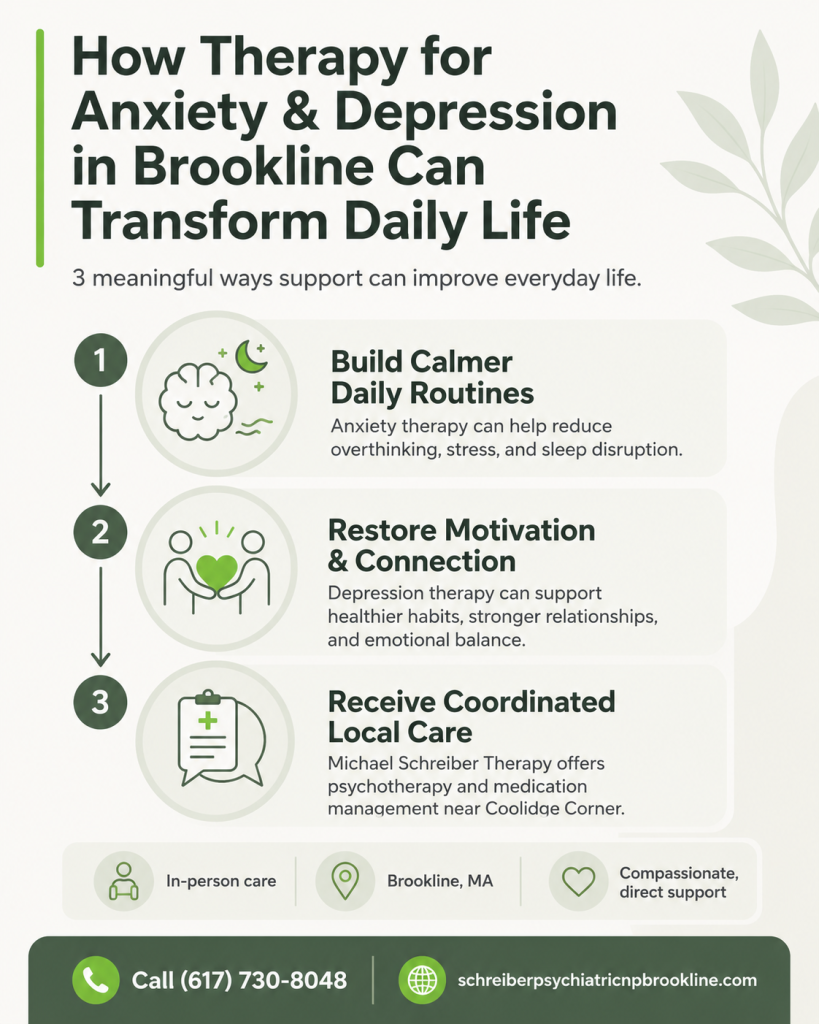
–Build calmer daily routines: Anxiety therapy in Brookline can reduce overthinking, stress, and sleep disruption.
–Restore motivation and connection: Depression therapy can support healthier habits, relationships, and emotional balance.
–Receive coordinated local care: Michael Schreiber Therapy offers psychotherapy and medication management near Coolidge Corner.
We at Michael Schreiber Therapy specialize in anxiety therapy, couples counseling, and medication management in Brookline, MA, serving Boston, Allston, Brighton, Cambridge, and Newton. Our work is patient-centered, direct, and compassionate, helping students, couples, adults, and members of the LGBTQIA+ community reduce symptoms, improve communication, and move toward steadier daily life. To schedule support, contact us or call (617) 730-8048.
Understanding Anxiety and Depression in Daily Life
Anxiety can create a constant sense of pressure, even when there is no immediate danger. You may replay conversations, worry about future events, avoid certain situations, or find it difficult to relax. Physical symptoms may include muscle tension, rapid breathing, stomach discomfort, sleep disruption, or a racing heartbeat.
Depression can affect motivation, energy, interest, and concentration. You may feel disconnected from activities or relationships that once mattered to you. Completing assignments, returning calls, preparing meals, or keeping up with household responsibilities may take more effort than usual.
Some people experience anxiety and depression at the same time. In these cases, anxious thoughts can create exhaustion, while low energy can make it harder to use healthy coping strategies. Anxiety depression treatment can help identify how these symptoms interact and which forms of support may be most useful.
How Anxiety Therapy in Brookline Can Create Calmer Routines
Anxiety therapy can help you recognize the thought patterns, habits, and situations that contribute to ongoing stress. Instead of reacting automatically to worry, you can learn to pause, evaluate what is happening, and choose a more helpful response.
Cognitive behavioral therapy for anxiety and depression often focuses on the connection between thoughts, emotions, physical sensations, and actions. For example, someone may believe that making a mistake at work will lead to serious consequences. That thought can create physical tension, avoidance, repeated checking, or difficulty sleeping.
Through CBT for anxiety, you can learn to examine these assumptions and respond with greater balance. This process does not involve pretending everything is fine. It helps you separate realistic concerns from patterns that increase distress.
Therapy may help you:
- Reduce repetitive worry and overthinking
- Develop healthier responses to stress
- Improve sleep and daily routines
- Communicate needs more clearly
- Manage academic or workplace pressure
- Build confidence in social situations
- Use breathing and body awareness to feel more grounded
These changes can make ordinary responsibilities feel less overwhelming and give you more room to focus on what matters.
How Depression Therapy Can Support Motivation and Connection
Depression often encourages withdrawal. You may cancel plans, stop exercising, put off responsibilities, or spend more time alone. Although withdrawal may provide temporary relief, it can also deepen feelings of isolation and reduce access to supportive people and activities.
A depression therapist can help you make gradual, realistic changes. Treatment may begin with small goals, such as creating a manageable morning routine, reconnecting with one trusted person, or completing a task that has been delayed.
Cognitive behavioral therapy for depression can help identify thoughts that reinforce hopelessness, guilt, or low self-worth. Psychodynamic therapy may explore past relationships, emotional patterns, and unresolved concerns that continue to influence the present.
Progress does not need to happen all at once. Consistent, achievable changes often create a stronger foundation than attempting to change every part of life immediately.
Therapy for Students in Brookline, Boston, and Cambridge
Brookline’s proximity to Boston and Cambridge makes it a convenient location for university, graduate, and PhD students seeking in-person mental health care. Academic life can bring intense workloads, social pressure, financial concerns, relationship changes, and uncertainty about the future.
Students may also struggle with perfectionism, ADHD, anxiety, depression, sleep disorders, or major life transitions. Therapy provides a private place to discuss these concerns without judgment.
Treatment can help students create more sustainable routines, set realistic expectations, improve time management, and respond to setbacks with greater flexibility. Medication consultation may also support students whose symptoms interfere with concentration, sleep, emotional regulation, or academic functioning.

Combining Psychotherapy and Medication Management
Some people benefit from psychotherapy alone. Others may find that medication for anxiety and depression improves their ability to participate in therapy and manage daily responsibilities.
When it comes to psychiatric care, the right plan should consider your symptoms, medical history, preferences, goals, and response to previous treatment. Medication management may include an initial consultation, education about available options, careful prescribing, and follow-up appointments to evaluate effectiveness and side effects.
Medication does not replace the work of therapy. It may reduce certain symptoms so you can sleep more consistently, think more clearly, or use coping strategies more effectively.
Michael Schreiber Therapy offers both psychotherapy and medication prescription and management from one private Brookline office. This integrated approach can create clearer communication and a more coordinated treatment plan.
Inclusive Mental Health Care in Coolidge Corner
Feeling respected by your therapist matters. Michael Schreiber Therapy provides patient-centered, LGBTQIA+ focused mental health care without bias. The practice also supports people in recovery and individuals managing anxiety, depression, mood and bipolar disorders, ADHD, relationship concerns, PTSD, and sleep difficulties.
The private office is located in the S. S. Pierce Building near the Coolidge Corner Green Line stop, making it accessible from Brookline, Boston, Allston, Brighton, Cambridge, and Newton.
Care draws from decades of work in social services, psychotherapy, nursing, psychiatric medication management, yoga, and fitness. This broad background supports a multimodal approach—one that considers emotional health, relationships, physical well-being, and the demands of everyday life.
Small Changes Can Reshape Daily Life
Therapy can support meaningful changes in how you move through each day. You may become better able to recognize anxiety before it escalates, communicate during difficult conversations, set boundaries, complete responsibilities, or respond to emotional discomfort without shutting down.
Over time, these changes can improve work, school, sleep, relationships, and self-confidence. Therapy cannot remove every challenge, but it can provide tools and support that make challenges easier to manage.
To discuss anxiety therapy, depression therapy, CBT, or medication management in Brookline, contact Michael Schreiber Therapy at (617) 730-8048. In-person appointments are available at the Coolidge Corner office.
Learn more at schreiberpsychiatricnpbrookline.com.
Check out other articles:
One Response