
Anxiety can be hard to explain when you are the one living with it. From the outside, your life may look organized, productive, and “fine.” Inside, though, you may feel tense, distracted, restless, overwhelmed, or exhausted from trying to keep everything together.
For many people in Brookline, Boston, Allston, Brighton, Cambridge, and Newton, anxiety shows up during life transitions, relationship stress, academic pressure, work demands, grief, recovery, identity concerns, or long-standing patterns that have become harder to manage. Anxiety is also common among college students, graduate students, PhD students, couples, and members of the LGBTIA community who may be carrying pressure that others do not always see.
Therapy for anxiety is not only for crisis moments. It can help you understand what is happening, reduce symptoms, build coping skills, and decide if additional support, including medication consultation, may be appropriate.
At Michael Schreiber Therapy in Brookline, care is patient-centered, practical, and grounded in a multi-modal approach that may include cognitive behavioral therapy, psychodynamic therapy, motivational interviewing, medication management, and mind-body tools such as breathing and yoga-informed practices.
In this article:
-Seek anxiety therapy in Brookline if worry, panic, or overthinking feels hard to control.
-Therapy can help reduce stress, improve coping skills, and support anxiety depression treatment.
-Michael Schreiber Therapy offers patient-centered care near Coolidge Corner for anxiety, mood, relationships, and medication support.
We at Michael Schreiber Therapy specialize in anxiety therapy, couples counseling, and medication management in Brookline, MA, serving Boston, Allston, Brighton, Cambridge, and Newton. Our work is patient-centered, direct, and compassionate, helping students, couples, adults, and members of the LGBTQIA+ community reduce symptoms, improve communication, and move toward steadier daily life. To schedule support, contact us or call (617) 730-8048.
1. Your Worry Feels Hard to Turn Off
Everyone worries. Anxiety becomes more disruptive when worry feels constant, repetitive, or difficult to control. You may replay conversations, anticipate the worst, or feel like your mind keeps scanning for problems even when things are going reasonably well.
This can affect sleep, focus, relationships, and your ability to feel present. Psychotherapy for anxiety can help you notice patterns in your thoughts and learn ways to slow the cycle before it takes over your day.
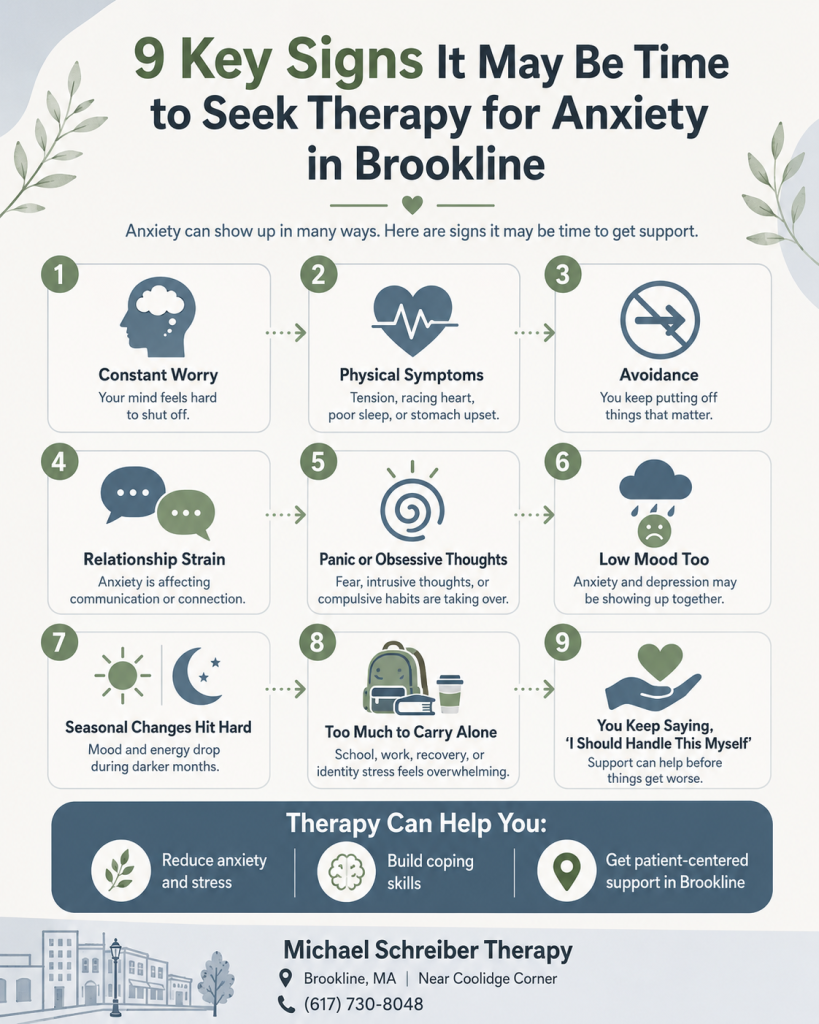
2. Anxiety Is Affecting Your Body
Anxiety is not only mental. It often shows up physically. You may notice tightness in your chest, stomach discomfort, headaches, muscle tension, shallow breathing, sweating, trembling, fatigue, or a racing heart.
Some people first seek help because their body feels like it is always on alert. In therapy, you can learn how anxiety affects the nervous system and practice tools that help your body settle. For some patients, medication for anxiety and depression may also be part of treatment when symptoms feel persistent or intense.
3. You Avoid Things That Matter to You
Avoidance can feel helpful in the moment. You skip the meeting, delay the difficult conversation, cancel the social plan, or avoid driving, dating, class, public speaking, medical appointments, or conflict.
The problem is that avoidance often makes anxiety stronger over time. Therapy can help you take small, manageable steps toward the parts of life you want back. This may include CBT for anxiety, exposure-based strategies, stress reduction, and coping skills that fit your daily life.
4. Your Relationships Are Feeling the Strain
Anxiety can make communication harder. You may seek reassurance often, shut down during conflict, become irritable, overthink your partner’s tone, or struggle to say what you need.
For couples, anxiety may show up as repeated arguments, emotional distance, difficulty trusting, or trouble navigating transitions. Couples counseling, couples therapy, marriage counseling, premarital counseling, and relationship counseling can help partners improve communication, reduce defensiveness, and understand each other more clearly.
When it comes to relationship therapists in Brookline, many people look for someone who can be direct, compassionate, and grounded. Michael Schreiber Therapy offers counseling that helps couples talk more honestly and work toward healthier patterns.
5. You Feel Stuck in Panic, Fear, or Obsessive Thoughts
Some people with anxiety have panic attacks. Others struggle with obsessive thoughts, compulsive behaviors, or a constant need to check, repeat, clean, research, confess, or seek certainty.
OCD therapy and cognitive behavioral therapy for OCD can help you understand the cycle of intrusive thoughts and compulsions. The goal is not to shame the thoughts or force them away. The goal is to reduce their control over your choices, your time, and your sense of peace.
6. Anxiety and Depression Are Overlapping
Anxiety and depression often appear together. You may feel nervous and exhausted at the same time. You may lose interest in things, isolate, feel low, sleep too much or too little, or have trouble getting started.
Depression therapy, CBT for depression, cognitive behavioral therapy for depression, and cognitive behavioral therapy for anxiety and depression can help you understand how thoughts, behaviors, mood, and stress connect. For some people, anxiety depression treatment may include therapy and anxiety depression medication. Medication consultation can help you consider options in a thoughtful, informed way.
7. Seasonal Changes Make Your Mood Worse
In Brookline and the greater Boston area, seasonal shifts can affect mood, energy, sleep, and motivation. Shorter days, colder weather, and less sunlight may make depression and anxiety harder to manage.
Seasonal depression treatment can help you plan ahead, build supportive routines, adjust coping strategies, and talk through treatment options. If you notice a pattern each year, it may be worth seeking help before symptoms deepen.

8. You Are Managing School, Work, Recovery, or Identity Stress Alone
Anxiety often grows when people feel they have to handle too much without enough support. University students, graduate students, and PhD students may face academic pressure, social transitions, financial stress, and uncertainty about the future.
People in recovery may need non-biased care that respects their history and supports continued growth. Members of the LGBTIA community may seek LGBTIA-focused mental-health care that feels respectful, informed, and steady.
Therapy gives you a private place to sort through these pressures with someone who listens carefully and helps you build practical next steps.
9. You Keep Thinking, “I Should Be Able to Handle This”
Many people wait to seek therapy because they believe their anxiety is not “bad enough.” They may tell themselves they should be stronger, more disciplined, more grateful, or more in control.
You do not need to wait until things fall apart. Therapy can help you reduce symptoms, strengthen coping skills, manage depression, decrease anxiety, improve relationships, and feel more like yourself again.
Common Reasons People Seek Anxiety Therapy in Brookline
People often reach out for anxiety therapy, psychiatric care, or medication prescription and management when they want help with:
- Constant worry, racing thoughts, or overthinking
- Panic symptoms, phobias, or avoidance
- Stress reduction and coping skills
- Anxiety and depression treatment
- ADHD medication treatment and focus concerns
- Sleep disorders and emotional regulation
- Mood and bipolar disorder support
- Bipolar disorder therapies or bipolar depression treatment
- Relationship stress, couples counseling, or marriage counseling
- Postpartum depression treatment and major life transitions
Every person brings a different story. Treatment should reflect your goals, your symptoms, your history, and the kind of support that feels useful to you.
Anxiety Therapy and Medication Management Near Coolidge Corner
Michael Schreiber Therapy is located in Brookline in the S.S. Pierce Building, right by the Coolidge Corner Green Line stop. The practice serves Brookline, Boston, Allston, Brighton, Cambridge, Newton, and nearby communities.
Michael opened this practice after years of community-based work in Boston and Worcester. His background includes social work, public school service, lived commitment during the AIDS epidemic, Iyengar yoga teaching, fitness instruction, nursing, and psychiatric nurse practitioner care. That range of training supports a generalist’s perspective, with therapy and medication management offered through a thoughtful, patient-centered lens.
Care may include CBT for anxiety, psychodynamic therapy, motivational interviewing, medication consultation, breathing practices, mind-body awareness, and practical strategies for daily life.
Talk With an Anxiety Therapist in Brookline
Anxiety can make life feel smaller, more tense, and more difficult than it needs to feel. Therapy can help you understand what is happening, reduce symptoms, improve communication, and build tools that support a better quality of life.
If you are looking for anxiety therapy, depression therapy, couples counseling, medication management, or psychiatric care in Brookline, Michael Schreiber Therapy can help.
Call Michael Schreiber Therapy at (617) 730-8048 or visit schreiberpsychiatricnpbrookline.com to learn more.
One Response